

Our Story · 3TE
A Legacy Written in the Sky
From a barnstormer's ambition to a beloved community airport, the story of Al Meyers and his field in Tecumseh, Michigan spans nearly a century of aviation history.
Where It All Began
Al Meyers Airport — FAA identifier 3TE — sits on the same Lenawee County ground where Al Meyers built some of the most respected light aircraft of the mid-twentieth century. The airport is both a working general aviation facility and a living memorial to one of Michigan's most inventive aviation pioneers.
A Century in the Making
Al Meyers Is Born
Allen H. Meyers is born on September 4, 1908, in Allenhurst, New Jersey, and grows up on a family farm near Middleburg, New York, at the foot of the Catskill Mountains. His father, trained as a mechanical engineer in Switzerland, passes on a love of precision and craft. Like so many boys of his generation, young Al is stirred by Lindbergh's flight and resolves to make aviation his life's work.
Learning the Trade
With no college offering aviation courses, Meyers learns with his hands. He works in sheet metal for Chance Vought, Glenn L. Martin, and the Stinson Aircraft Corporation in Wayne, Michigan. He solos a Curtiss Jenny at Curtiss Field on Long Island in 1928, then barnstorms through Tennessee, Georgia, and Michigan county fairs. The rides and aerobatic exhibitions fund a larger ambition: he studies drafting and mathematics at night, and in a one-car garage in Wayne begins building an airplane of his own design.
The OTW Takes Flight
The Meyers OTW — "Out To Win" — makes its first test flight at the old Wayne County Airport in the spring of 1936. Its all-metal fuselage, wide landing gear, and light wing loading make it a forgiving trainer that can absorb a student's landing. In 1939 it receives its Approved Type Certificate from the Civil Aeronautics Authority.
A Field Is Founded
With the OTW approved for the Civilian Pilot Training Program and a government contract in hand, Meyers needs a factory and a flying field. A group of Tecumseh citizens — Dr. Hammel foremost among them — invite him to bring the enterprise to their town and promise tax consideration while the business establishes itself. Meyers accepts. He settles in the area in 1939, and the airfield north of town is laid out in 1939 and 1940. For more than three decades it is known as the Tecumseh Municipal Airport.
Wartime Production
On the field at Tecumseh, Meyers and his crew build more than one hundred OTWs. Most go to war as primary trainers, serving at fields across the country, including the high-altitude training base at Minden, Nevada. The earliest airplanes fly behind Warner Scarab radial engines; later models carry the 160 hp Kinner R-56. The OTW earns a reputation as an exceptional aerobatic trainer, and Meyers takes particular pride in its safety record — insurance underwriters later report no student or instructor killed in an OTW during the entire wartime training program.
Boats, Jeeps, and New Designs
When the government contract ends near the close of the war, Meyers turns the shop's expertise in aluminum, riveting, and welding toward an all-aluminum sport boat to keep his skilled workforce together. The plant also builds Jeep cabs and winterization kits for the Army. The Meyers boats win a name of their own for quality and safety, and the income they produce carries the company through the long and costly work of developing new airplanes.
The Meyers 145 and 200
The Meyers 145 — a sporty two-place, all-metal, low-wing airplane with retractable main gear — nearly costs its designer his life during spin testing, when the prototype enters a flat spin and Meyers is forced to bail out, shattering his right ankle on landing. He wills himself back onto his feet, corrects the flaw, and earns the type certificate. He then turns to the growing market for business and family travel, producing the Meyers 200: a four-place, low-wing airplane with retractable tricycle gear, built with a steel structure and aluminum surfaces. Admired for its speed, strength, and workmanship, private owners carry it to victory in air races around the country.
Rockwell Acquires the 200
Building airplanes in quantity demands more capital than one man can raise. Rockwell, through its Aero Commander division, purchases the design and manufacturing rights to the Meyers 200. Production moves to Albany, Georgia, where the airplane is built as the Aero Commander 200. The sale allows Meyers, for the first time, to pay off the mortgage on his land. The Tecumseh plant becomes an FAA-approved repair station, and owners of Tecumseh-built Meyers airplanes continue to return to the field for overhauls and repairs.
Honors and a Final Landing
In 1971 Meyers undergoes surgery for long-standing hypertension and suffers a stroke that weakens his right side and impairs his speech. He meets the illness with the same determination that carried him through the building of three airplanes. In 1974 he is elected to the OX-5 Pioneer Aviation Hall of Fame and stands to receive the honor despite his weakened condition. In 1975 the field he built is renamed Al Meyers Airport. He dies in his sleep on March 15, 1976, and is laid to rest in Brookside Cemetery in Tecumseh.
Recognition and Continuity
In 1987 the Michigan Bureau of History erects a state historical marker at the airport commemorating the field and its founder. In 2001 Allen H. Meyers is enshrined in the Michigan Aviation Hall of Fame. In 2014 the airport passes to new ownership. Today, pilots find the same ground where Al Meyers once tested his airplanes — the original hangars still stand, the Michigan historical marker still greets visitors on Macon Highway, and Meyers airplanes, some of them built on this very field, still return to the place where their story began.
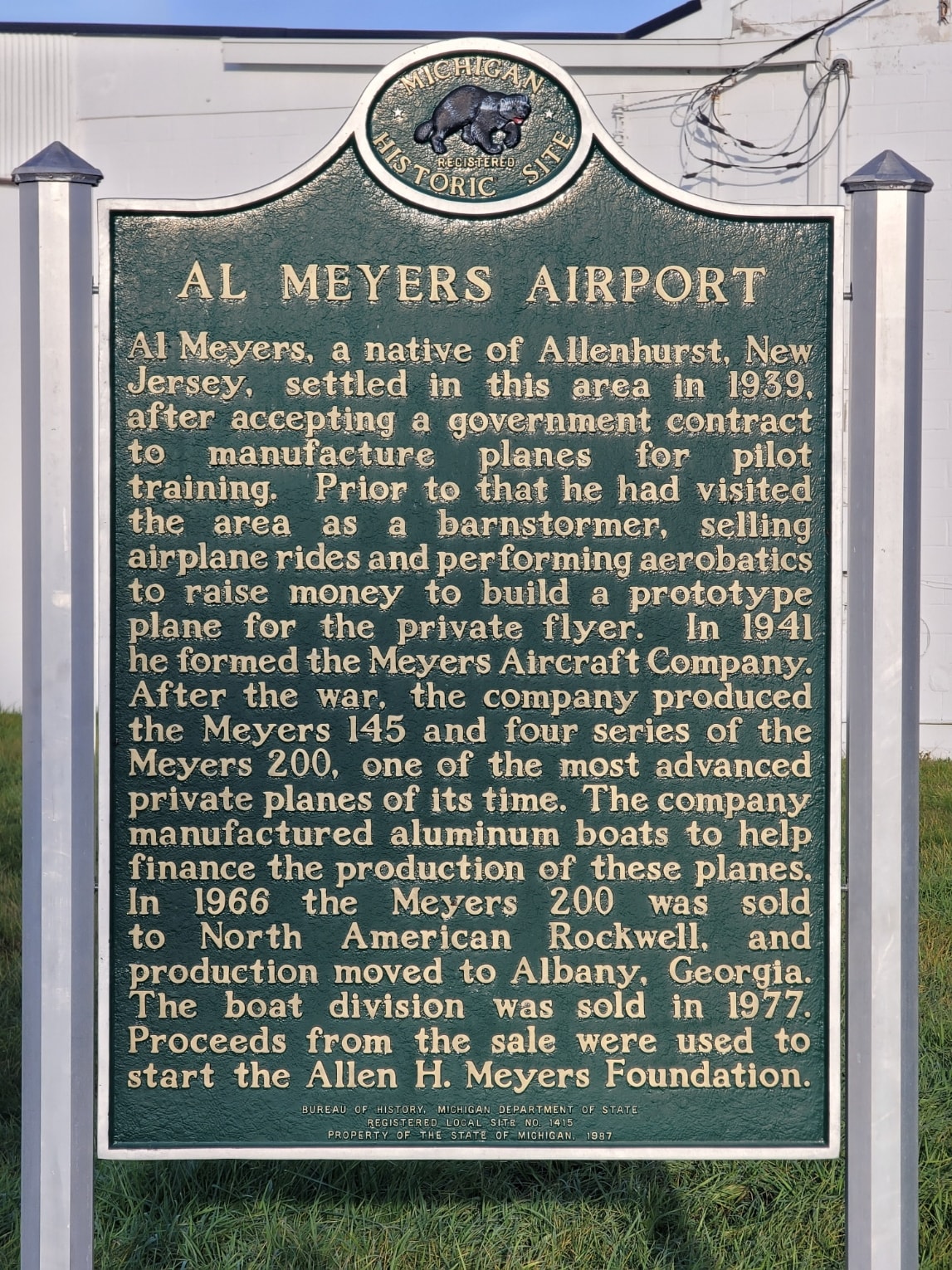
A State Historical Marker
In 1987 the Michigan Bureau of History erected this marker at Al Meyers Airport, recognizing the field and its founder as a registered historic site. It stands on Macon Highway today, greeting every pilot and visitor who arrives at 3TE.
In 2001 Allen H. Meyers was enshrined in the Michigan Aviation Hall of Fame — a fitting capstone to a career that began in a one-car garage and produced aircraft still flying today.
The Aircraft He Built
The Meyers 200 remains the crown jewel of the company's output — a low-wing, retractable-gear monoplane capable of cruising at over 200 mph on a single piston engine. Every airplane that left the Tecumseh plant was first flight-tested by Meyers himself, and he would not release one until it flew exactly as he wanted it to. Fewer than 100 were built, making surviving examples rare and prized. Meyers 200s still fly today, a testament to the quality of their original construction.
Quality is remembered long after the price is forgotten.
— Al Meyers

A Community Treasure
Today, Al Meyers Airport honors its namesake not with a museum or a monument, but with something more fitting: a runway. Pilots still fly in and out of 3TE every week, carrying on the tradition of general aviation that Al Meyers helped build. Al and his wife Nydia founded the Allen H. Meyers Foundation in 1966, which continues to support students in science and aviation. The airport is a reminder that great things in aviation don't always come from big cities or big companies — sometimes they come from a determined man in a small Michigan town.
Come See It for Yourself
Whether you're a pilot looking for a home base or a history enthusiast curious about Michigan's aviation past, you're welcome at 3TE.